Last Friday morning, my husband Bill and I arrived at York High School right at 9 a.m. After making our way through security, we headed to the auditorium.
It was empty, but I couldn’t help thinking about all the memories I had of that space. So much of what I do today has its roots on that stage.
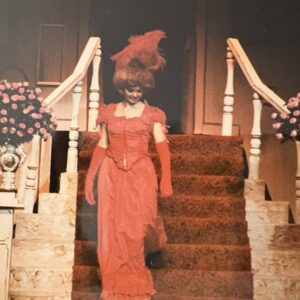
One of my favorite memories is playing Dolly Levi in our senior-year production of Hello, Dolly! Our director, Les Zunkel, had beautiful period costumes made for the show, including a red taffeta dress I still have. I wore it for my grand entrance down a staircase, singing, “Hello, Harry! Well, hello, Louis! It’s so nice to be back home where I belong.”
I’d returned to York to receive a Dukes of Distinction award the evening before, alongside nine fellow alumni whose accomplishments and life stories were remarkable. It was a wonderful evening, made even more special by my family and friends who came to celebrate with me—including my eighth-grade shop teacher, Mr. Sanderson, and his wife.
But Friday was what I was especially looking forward to—talking with students about finding your voice. I wanted them to understand that their unique experiences and ways of seeing the world are among the most valuable things they bring to any speech or conversation.
One of the York teachers had told me that his public speaking students are sometimes so concerned about what others might think that they’re reluctant to take risks or speak up about something they believe.
Well, some things never change!
I work with adults who struggle with exactly the same concerns, whether they’re 27 or 82. (And yes, I’ve coached an 82-year-old.)
Which led me to a question I posed to the students:
What’s wrong with being weird?
I’d recently watched an interview with musician Jon Batiste on 60 Minutes. He shared how his unconventional approach to music at Juilliard didn’t always fit the school’s expectations. In fact, they sent him to see a psychologist.
And do you know what the psychologist told him?
“You may be weird, but you’re alright, son.”
I shared that story with the students, along with a short video of Batiste bringing his music into the New York subway, where commuters suddenly found themselves part of a spontaneous musical experience—which Batiste called a “love riot.”
So I asked them:
What if something that makes you different is also something that gives you an advantage?
And what might happen if you gave yourself permission to be a little more of who you actually are?
At one point, I invited students onto the stage for a quick before-and-after breathing exercise. Each introduced themselves with the words, “My name is ______. I have something to say.” We explored how taking a deep breath and using that air to propel their voices could help them sound—and feel—more confident.
I had no shortage of volunteers! And that was one of the things I loved about the morning. The students were attentive, curious, and willing to participate, even when it meant stepping onto a stage in front of their classmates.
Later, as we toured the school, I had the opportunity to meet more students. Our student ambassador, Sam, was a delightful young woman hoping for early admission to Barnard College in New York. I was struck by the poise and thoughtfulness of the young people we met, the questions they asked, and their enthusiasm for what lay ahead.
I came away feeling genuinely hopeful about this generation.
Friday night, the Dukes of Distinction honorees were introduced on the field before York’s football game. Bill, who had served as York’s Performing Arts Department Chair and marching band director alongside Mike Pavlik, and I stayed to watch the halftime show and visit with the band students.
And then came one of my favorite moments of the day.
As we were standing there, Phoenix, a young woman from my morning workshop, came walking toward me in her marching band uniform. She’d been one of the students who volunteered to come up onstage and practice using her voice.
She gave me a big hug.“I loved your presentation!” she said, with a huge smile.
And I thought about how the day had begun, standing in that empty auditorium, remembering my own years on that stage.
Now, decades later, here was a young woman who had stepped onto that same stage, taken a little risk, and found something worthwhile in the experience.
I hope she’ll keep raising her hand, trying things that feel a little uncomfortable, and discovering what makes her different.
We need their unique voices.
As for the rest of us?
Maybe we could all stand to give ourselves a little more permission to be, well, weird. To try something new. To say what we think. To pursue an idea that might seem a little unusual to somebody else.
After all, finding your voice isn’t something you finish doing when you graduate from high school.
It’s something you keep doing throughout your life.
Leave a Reply